August 19, 2026
# The Role of Digital Marketing in Business Growth: Strategies That Deliver Results
Digital marketing has become an essential part of how businesses attract customers, build credibility, and generate revenue. A strong online presence is no longer limited to having a website or social media account. Businesses need a structured digital marketing strategy that connects their brand with the right audience at the right stage of the buying journey.
Apex Infinity Tech
Apex Infinity Tech
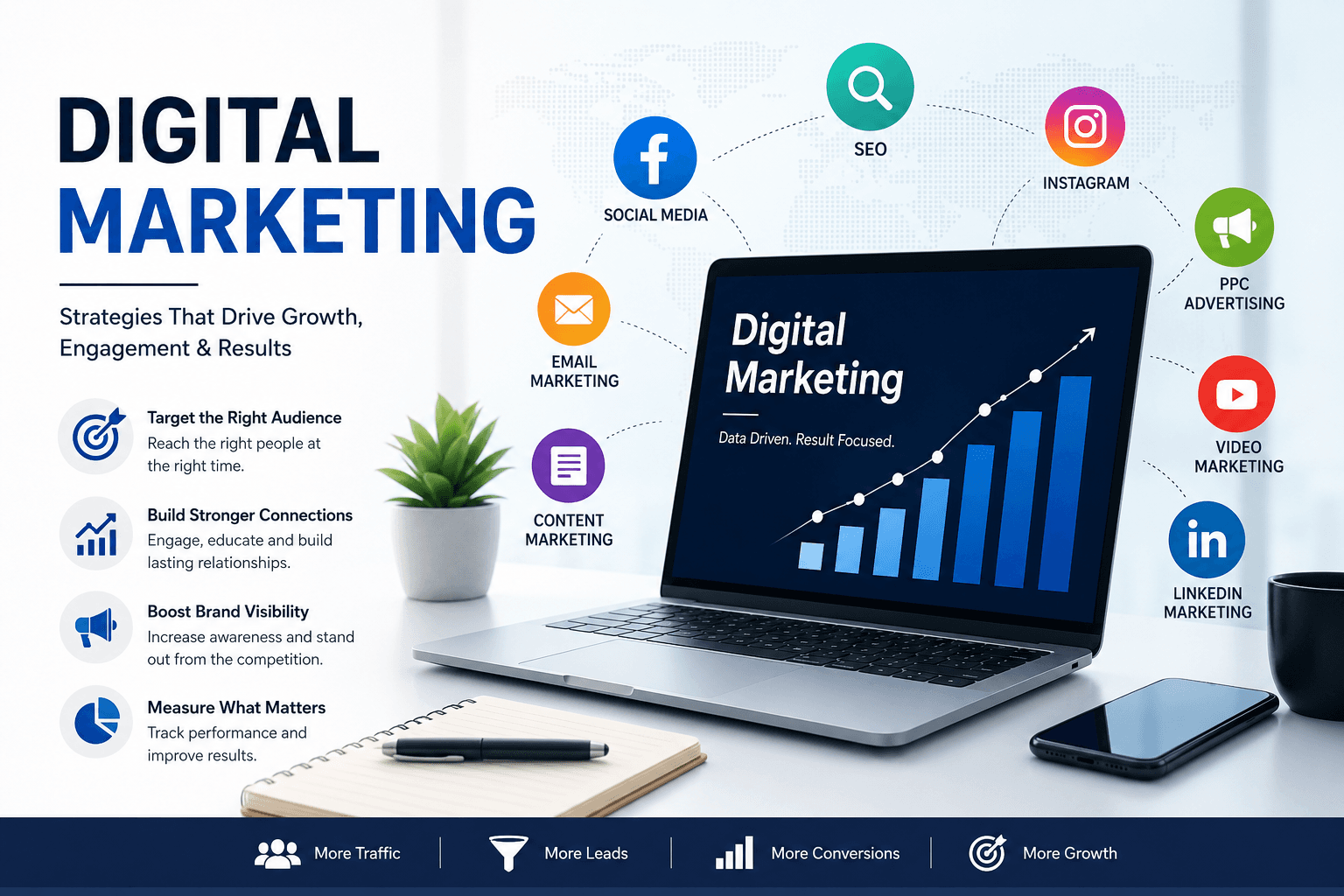
The Role of Digital Marketing in Business Growth: Strategies That Deliver Results
Digital marketing has become an essential part of how businesses attract customers, build credibility, and generate revenue. A strong online presence is no longer limited to having a website or social media account. Businesses need a structured digital marketing strategy that connects their brand with the right audience at the right stage of the buying journey.
From search engine optimization and paid advertising to social media, content marketing, and email campaigns, digital channels provide businesses with multiple ways to reach potential customers and measure their marketing performance.
Why Digital Marketing Matters for Modern Businesses
Customers now research companies online before making purchasing decisions. They compare websites, reviews, social media profiles, products, services, and pricing before contacting a business.
This makes digital visibility an important part of the customer journey.
A well planned digital marketing strategy helps businesses:
- Reach targeted audiences
- Generate qualified leads
- Increase website traffic
- Build brand awareness
- Improve customer engagement
- Track marketing performance
- Reduce dependence on traditional marketing
- Increase sales opportunities
1. Search Engine Optimization
Search engine optimization, commonly known as SEO, helps a website appear in search engine results when potential customers search for relevant products or services.
A successful SEO strategy includes:
- Keyword research
- Technical SEO
- On page optimization
- Website structure
- Content development
- Internal linking
- Local SEO
- Backlink development
- Website performance optimization
For example, a company providing industrial equipment can target searches related to its products, applications, industries, and locations. Creating useful pages around these search terms can help the company reach customers who are already researching a solution.
2. Performance Marketing
Performance marketing focuses on measurable results from paid advertising campaigns.
Platforms such as Google Ads, Meta Ads, and LinkedIn Ads allow businesses to target specific audiences based on factors such as location, industry, interests, search behaviour, job role, and demographics.
A performance marketing campaign should not be judged only by the number of clicks.
Important metrics include:
- Cost per lead
- Conversion rate
- Qualified leads
- Customer acquisition cost
- Return on advertising spend
- Sales generated
3. Social Media Marketing
Social media provides businesses with a direct communication channel with their audience.
Platforms such as LinkedIn, Instagram, Facebook, and YouTube can be used for different marketing objectives.
For B2B companies, LinkedIn can support thought leadership, professional networking, and lead generation. Instagram can help businesses showcase products, projects, company culture, and visual content. YouTube can support detailed product demonstrations, educational videos, interviews, and customer stories.
Effective social media marketing requires consistency.
Businesses should maintain a content strategy covering topics such as:
- Industry insights
- Product information
- Customer problems and solutions
- Case studies
- Company updates
- Educational content
- Product demonstrations
- Industry trends
4. Content Marketing
Content marketing helps businesses attract potential customers by providing useful information.
Instead of focusing only on promotional messages, businesses can create content that answers common customer questions and explains industry problems.
Examples include:
- Blog articles
- Guides
- Case studies
- Whitepapers
- Videos
- Infographics
- Research reports
- Product comparisons
- Frequently asked questions
A single detailed article can become a LinkedIn post, carousel, short video, email campaign, and sales resource.
5. Website Development and Conversion Optimization
Digital marketing brings people to a website, but the website needs to convert that traffic into enquiries, registrations, calls, or purchases.
A business website should have:
- Clear navigation
- Mobile responsiveness
- Fast loading speed
- Strong website structure
- Relevant content
- Clear calls to action
- Simple enquiry forms
- Trust signals
- Search engine friendly pages
The website should make it easy for visitors to understand what the company offers, why it matters, and what action they should take next.
6. Email and WhatsApp Marketing
Email and WhatsApp marketing can help businesses stay connected with existing customers and prospects.
These channels can be used for:
- Product announcements
- Offers
- Event invitations
- Follow ups
- Newsletters
- Lead nurturing
- Customer updates
- Sales communication
Relevant messaging, proper segmentation, and consistent follow up can significantly improve campaign performance.
7. Data Driven Marketing
One of the biggest advantages of digital marketing is access to performance data.
Businesses can identify:
- Which campaigns generate leads
- Which keywords attract customers
- Which pages receive the most traffic
- Which advertisements perform best
- Which audiences convert
- Where customers leave the website
- Which channels generate revenue
For example, if one advertising campaign generates 100 leads but another generates 30 highly qualified leads at a lower cost per customer, the second campaign may have greater business value.
8. Digital Marketing for B2B Companies
B2B marketing requires a different approach because purchasing decisions often involve multiple people and longer sales cycles.
A B2B digital marketing strategy can combine:
- SEO
- LinkedIn marketing
- Google Ads
- Email marketing
- Website development
- Industry focused content
- Lead generation campaigns
- Case studies
- Account based marketing
9. Building an Integrated Digital Marketing Strategy
The strongest digital marketing programs do not treat every channel as a separate activity.
SEO can bring organic traffic.
Paid advertising can generate immediate visibility.
Social media can build brand awareness.
Content can educate prospects.
Email and WhatsApp can support follow ups.
The website can convert visitors into enquiries.
Sales teams can then move qualified leads through the sales process.
When these activities work together, businesses can create a more consistent customer journey.
How to Measure Digital Marketing Success
The right metrics depend on the business objective.
For brand awareness, businesses can monitor reach, impressions, video views, and audience growth.
For lead generation, useful metrics include website enquiries, qualified leads, cost per lead, and conversion rate.
For ecommerce businesses, important metrics include sales, average order value, customer acquisition cost, and return on advertising spend.
The most important measurement is ultimately business impact.
A campaign that generates traffic but no meaningful enquiries may need improvement. A campaign that generates fewer visitors but consistently produces qualified customers may be more valuable.
The Future of Digital Marketing
Digital marketing is becoming increasingly data driven and personalized. Artificial intelligence is also changing how businesses conduct research, create content, analyze customer behaviour, automate campaigns, and improve decision making.
However, technology does not replace strategy.
Businesses still need a clear understanding of their target audience, market position, customer needs, competitive environment, and commercial objectives.
The companies that perform well online will be those that combine technology with strong marketing fundamentals.
Conclusion
Digital marketing is not simply about posting on social media or running advertisements. It is a complete business growth system that connects visibility, content, technology, customer engagement, lead generation, and measurable results.
A successful strategy starts with clear objectives and the right audience. From there, businesses can select the channels that support their goals and continuously improve performance using real data.
For businesses investing in digital growth, the focus should remain simple: reach the right people, provide useful information, build trust, generate qualified opportunities, and measure what contributes to business growth.